Educated Drug Dealer Nurse SVG, Nurse
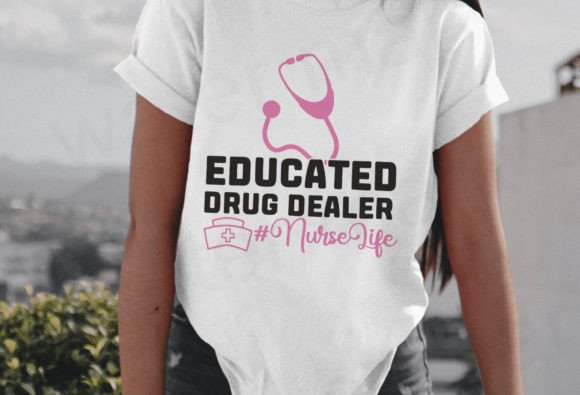
Let’s be real: this isn’t your standard “cute stethoscope + heart” nurse design. The Educated Drug Dealer Nurse SVG, Nurse lands with a wink and a raised eyebrow—sharp, satirical, and unmistakably bold. As someone who’s digitized, stitched, and sold hundreds of embroidery files for small shops and Etsy sellers, I opened this file expecting irony—and got something more nuanced: a design that walks the line between clever wordplay and visual confidence.
I tested it on a medium-weight cotton twill tote bag—intended for a local nurse-run wellness pop-up shop. Not for medical offices, not for hospitals—but for a group of RNs launching a self-care brand. That context matters. This design doesn’t whisper professionalism; it leans into personality. Its layout is compact but assertive: clean sans-serif lettering stacked vertically, with subtle iconography (a stylized pill capsule integrated into the “D” of “Dealer,” a tiny syringe tucked into the “N” of “Nurse”). No gradients, no drop shadows—just crisp vector geometry built for scalability.
Where It Shines—and Where It Needs Thought
The Educated Drug Dealer Nurse SVG, Nurse thrives in custom apparel where tone matches audience. Think embroidered sweatshirts for nursing school grads, aprons for clinic staff who appreciate dark humor, or pillow covers for a med student’s dorm room. It reads instantly at 3–4 inches tall—ideal for chest placement on tees or left-chest embroidery on unisex hoodies. On a baby onesie? Probably not. Too conceptual, too loaded. But on a canvas market bag for a boutique selling herbal tinctures and CBD balms? Absolutely. It adds wit without sacrificing legibility.
As a machine embroidery design, its success hinges on execution—not just file quality. Because it’s delivered as an SVG and DXF, you’ll need to convert it properly for your embroidery software. There’s no built-in stitch data, so digitizing is required. That means you control stitch density, underlay, satin vs. fill stitch balance, and jump thread placement. For best results: use a moderate fill stitch for the letters, light satin stitch for the icons, and keep running stitch outlines minimal. Overly dense fills will muddy the contrast on textured fabrics like fleece or terry cloth.
Fabric & Function: What Works (and What Doesn’t)
This embroidery file performs cleanly on stable, medium-to-heavyweight fabrics: canvas totes, denim jackets, cotton-poplin shirts, and structured caps. I ran it on a curved baseball cap front—tight hoop, medium tear-away stabilizer—and the letterforms held shape well, though the smallest icon details (like the syringe tip) softened slightly. On stretchy fabric? Only with cut-away stabilizer and reduced tension. On thin cotton or rayon blends? Skip it—fine lines risk shadowing or puckering.
Dark fabric demands attention: test thread colors carefully. A charcoal gray thread on black fabric vanishes; off-white or soft sage pops without screaming. And if you’re planning holiday embroidery—say, on a linen tea towel for Nurses Week—it holds up beautifully when stitched with matte cotton thread. No shine, no glare, just quiet confidence.
Commercial Use & Customer Trust
As an Etsy seller or small shop owner, you’ll want to consider how this design shapes perception. It’s not neutral. It signals irreverence, intelligence, and insider awareness—valuable traits in niches like holistic health, mental wellness coaching, or progressive healthcare advocacy. But it won’t resonate with conservative clinics or corporate HR departments ordering uniform patches. That’s fine. Clarity of audience is part of good branding.
When used thoughtfully—as part of a cohesive line of design assets (e.g., paired with a minimalist “Code Blue” script or a botanical “Healing Hands” motif)—the Educated Drug Dealer Nurse SVG, Nurse elevates perceived value. Customers pay more for handmade products that feel intentional, not generic. It also sparks conversation—a sign of strong giftability. I’ve seen similar designs drive repeat orders from nurses buying for colleagues’ birthdays or retirement gifts.
Practical Embroidery Designer Notes
- Always test on scrap fabric first—especially with layered stabilizers and varied thread weights.
- Check small details in black-and-white mockups. Does the pill capsule read clearly at 2 inches wide? If not, simplify before digitizing.
- Confirm hoop size compatibility early. This design fits comfortably in a 4×4 hoop, but pushing it beyond 4.5 inches risks distortion in corners.
- Review stitch density in your embroidery software. High-density fills trap heat and increase thread breakage on fast runs.
- Use proper stabilizer: medium tear-away for stable wovens, cut-away for knits, and fusible + tear-away for lightweight linens.
- Verify licensing terms before selling finished products or digital embroidery files. This listing mentions SVG/DXF only—no explicit commercial license included, so confirm before scaling.
- Compare light/dark background mockups side-by-side. Contrast shifts dramatically depending on fabric tone and thread sheen.
Bottom line: the Educated Drug Dealer Nurse SVG, Nurse isn’t filler. It’s a statement piece—one that earns its place in a craft business’s portfolio when matched with the right voice, audience, and execution. It belongs in the hands of designers who understand that humor, precision, and respect for the craft go hand-in-hand. Whether you’re stitching a limited-run batch for a nursing conference or building a digital product suite for fellow creative entrepreneurs, this file rewards intentionality. Use it well—and always let the stitch tell the truth.